How to Track AI Search Citations & Sources
Find out which of your pages AI engines cite, how often, and for which prompts, so you can double down on the content that earns mentions.
When an AI engine answers a question, it pulls from sources. The Citations tab shows you exactly which pages get cited in your space, how often, and whether your brand is mentioned on them.
It tells you what content actually earns AI mentions, and where competitors are getting named while you’re left out.
The tab has two views: Sources and Mention Gap.
Sources: every page AI cites
The Sources tab lists every page AI engines pull from for your prompts. Use Group by URL to see individual pages, or switch the grouping to roll them up by domain.
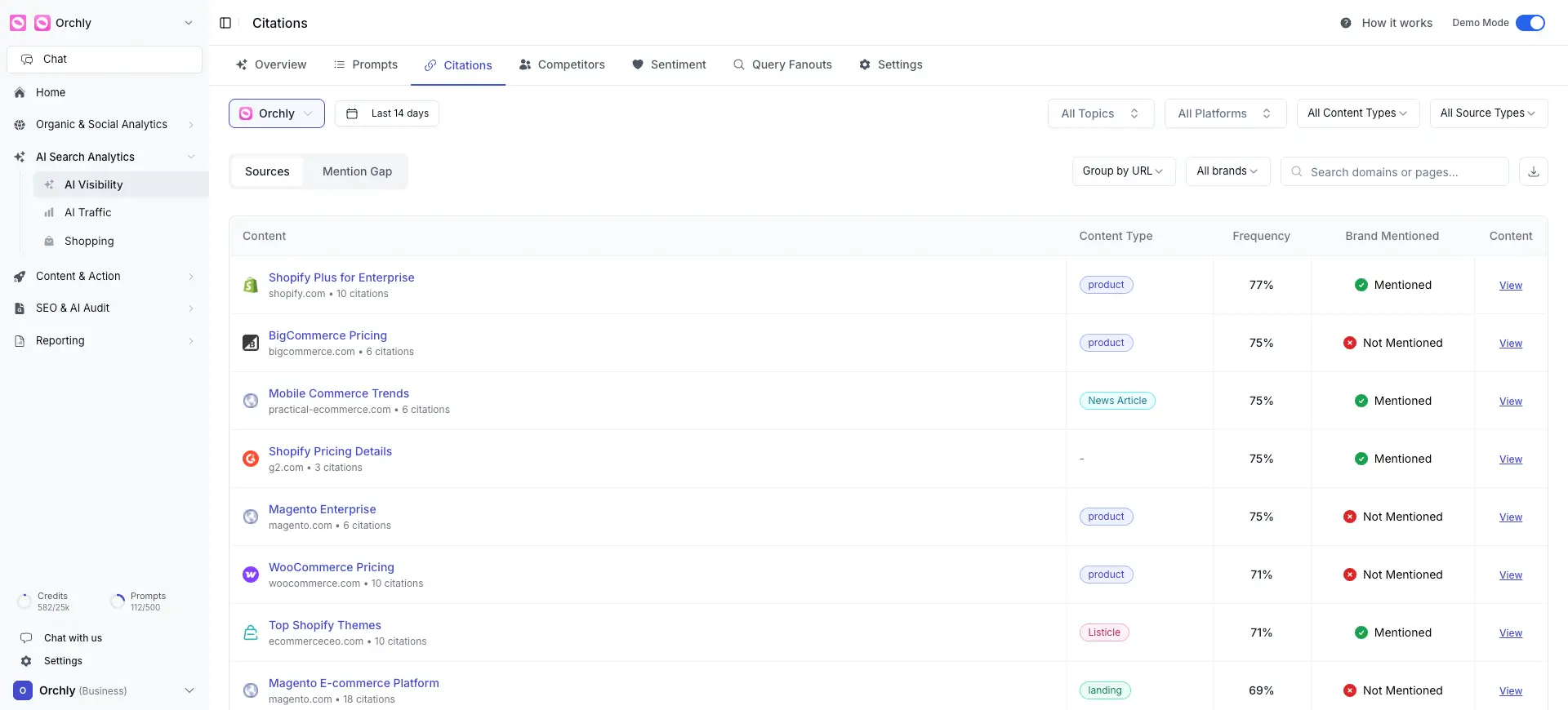
Each row shows:
| Column | What it tells you |
|---|---|
| Content | The cited page, its domain, and how many citations it earned |
| Content Type | The kind of page: product, listicle, news article, landing, and so on |
| Frequency | How often this source is cited for your prompts |
| Brand Mentioned | Whether your brand appears on that page, Mentioned or Not Mentioned |
The Brand Mentioned column is the one to scan. A high-frequency source that AI keeps citing but where you’re Not Mentioned is a page you want to get onto.
Filter by topic, platform, content type, and source type, search for a domain or page, or export the list.
Mention Gap: where competitors win and you don’t
This is the part you won’t find in a normal analytics tool. Orchly reads the actual content of every cited page and records which brands each one names. The Mention Gap tab turns that into a side-by-side grid.
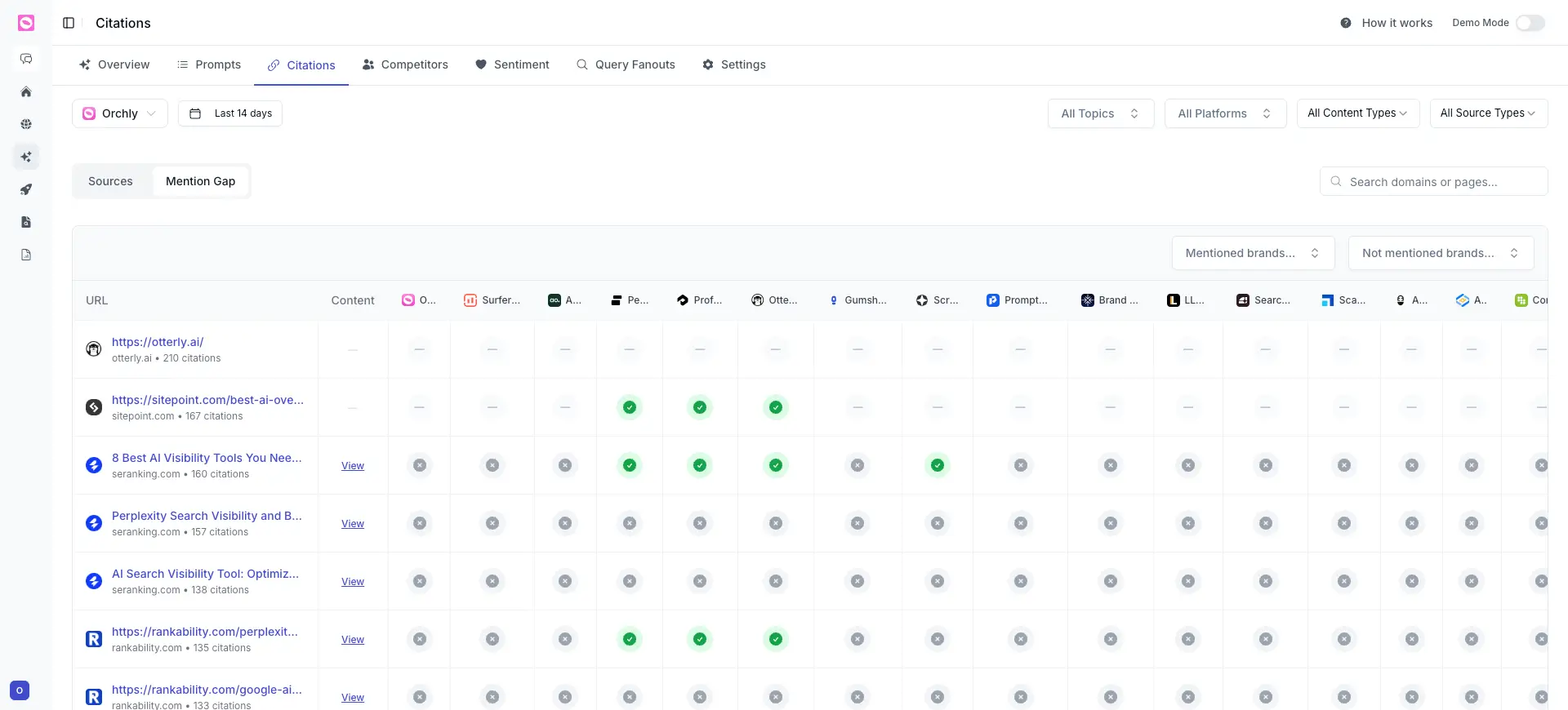
Each row is a cited URL. Each column is a brand, you and your competitors. A check means that page mentions the brand; a cross means it doesn’t.
Read across a row and the gap is obvious: a page that AI cites heavily, where three competitors have a check and you have a cross, is a page actively shaping AI answers without you in it.
Use the Mentioned brands and Not mentioned brands filters to cut straight to the gaps, for example, every cited page that mentions a specific competitor but not you.
The pages where competitors are mentioned and you aren’t are your highest-leverage work. Pitch the publisher, earn a listing, or write a stronger page of your own. Each one you close is a source that starts feeding your brand into AI answers instead of theirs.
Citations alone tell you which pages AI trusts. Reading the content of those pages tells you who’s already winning them. Together, that’s a precise map of where to put your outreach and content effort, ranked by how much AI already leans on each source.